Architecture
TIMBER turns a multichannel time series into representations in four steps. The tokenizer cuts the signal into temporal patches and embeds them; the contextualizer gives every patch its context across channels and time; the encoder summarises all the contextualized patches of an entity into a few latent embeddings; and a task module uses them: pretraining decoders during pretraining, a head during finetuning. Each module is one class of the package, and each can be resized or switched off by configuration.
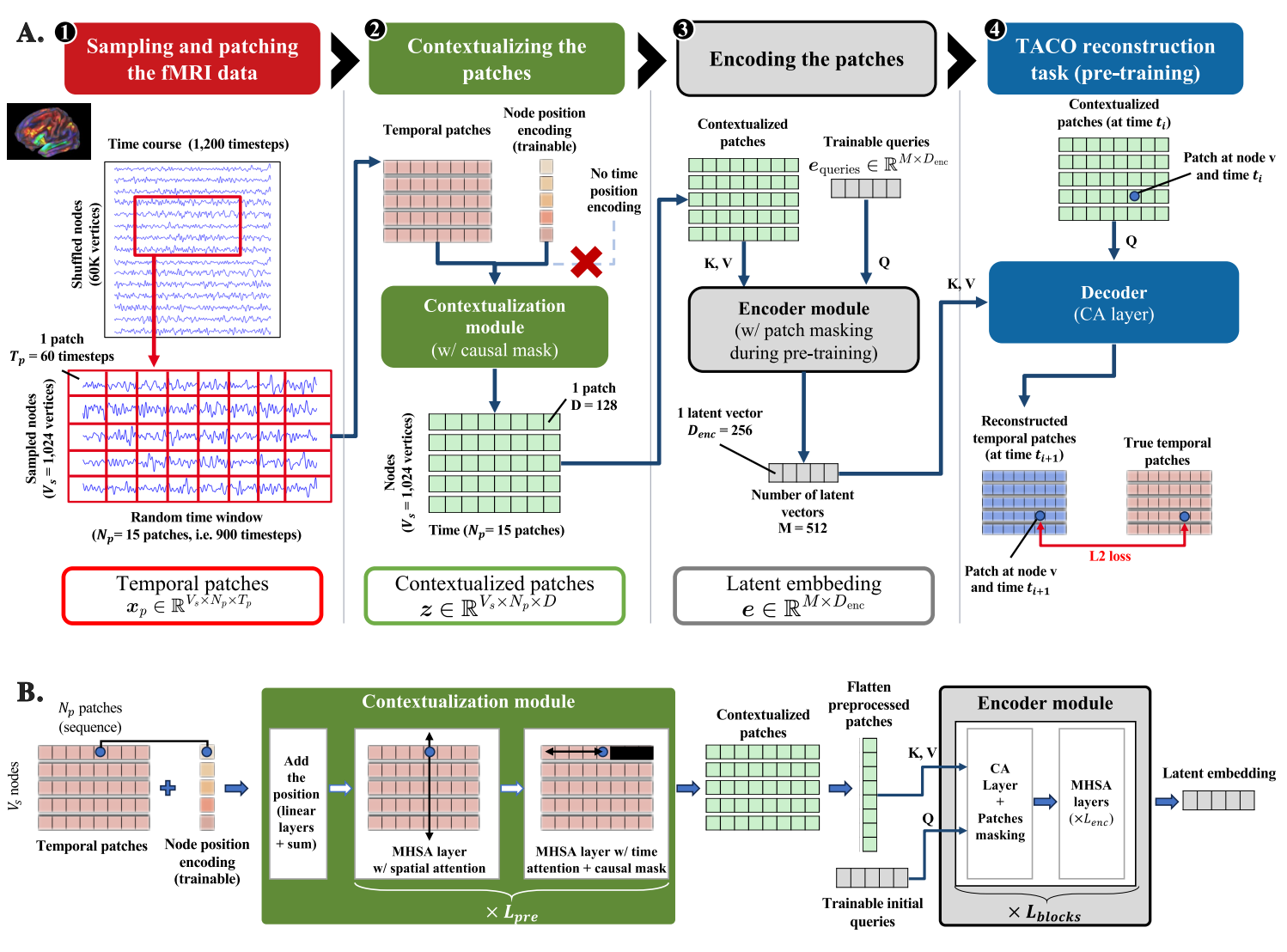
Figure: (A) the four stages; (B) the contextualization and encoder modules (paper, architecture figure).
signal (entity, channel, time)
  -> tokenizer          temporal patches x_p + channel embeddings        (entity, channel, patch, patch_length)
  -> contextualizer     contextualized patches z                          (entity, channel, patch, dim)
  -> masking            hides a fraction of the patches (pretraining only)
  -> encoder            latent queries e_queries read the patches -> latent embedding e   (entity, latent, dim)
  -> decoders (pretraining)   or   head H (finetuning, plugged after the encoder)
The terms follow the paper: temporal patches x_p (the raw patches), contextualized patches z (after the
contextualizer), latent queries e_queries (the learned queries of the encoder) and latent embedding e (its
output). The modules are named C (contextualizer), E (encoder), D (decoders) and H (head), as in the paper.
Shapes
signal has shape (*batch, channel, time). The batch axes are decomposed as follows:
- the first batch axis is the entity: the thing that carries the label (a subject, a patient, a device). The latent embedding and the head are computed per entity;
- the other batch axes are views of the entity, that is different samples of the same entity: recordings, channel chunks and time chunks. The head combines the views of an entity (see Finetuning heads).
A channel chunk is a random subset of the channels of a recording, and a time chunk is a window of consecutive time points. The sampler draws them at random for every sample (see Data pipeline). This is the paper's way of working with long recordings: the model sees many small random views of the same entity, which is cheap to compute and makes the representation robust to the choice of channels and of the time window.
channel indexes the channel embeddings of the tokenizer: pass channel_indices to feed a subset of them.
time is the number of samples; it is cut into non-overlapping patches of patch_length samples.
Pretraining objectives
TimberForPretraining runs the four steps and then the decoders listed in config.decoders. Three objectives are
available, each a DecoderConfig:
- TACO (
forecasting_1, the default): the contextualized patch of each channel at time i predicts the patch that follows it, i + 1, of the same channel, with the latent embedding as context. It needs the causal mask of the contextualizer, so that the query cannot see the patch it predicts. TACO is what makes the contextualized patches informative, and it needs no explicit time-position embedding. - Forecasting at horizon k (
forecasting_<k>): the same task, predicting the patch k steps ahead. The paper uses k = 1. - Vanilla reconstruction (
reconstruction): the decoder predicts a masked patch from its position embedding (channel and time), without a query from the signal. This objective needs explicit time-position embeddings and a non-causal contextualizer. The ablation study of the paper shows that TACO gives better representations than this objective (see Results).
The paper also shows that adding time-position embeddings to TACO hurts the representations, so the default is TACO without them.
Patch masking (patch_mask_ratio, 0.7 in the paper) happens after the contextualizer and before the encoder: the
contextualized patches of the masked positions are dropped, and the encoder only reads the others (see Encoder).
Finetuning
TimberForPrediction runs the same steps, then the head H is plugged after the encoder: it pools the latent
embedding and predicts a regression or classification target. The paper fine-tunes the encoder and the head, and keeps
the tokenizer and the contextualizer frozen (the figure of the framework shows the frozen and trainable modules). The
decoders can also be trained jointly, for example with TACO as an auxiliary objective.
Configuration
Every module has its own dataclass, and TimberConfig groups them. The architecture is saved in config.json; the
optimisation settings are a separate object (TimberTrainingConfig) and are not saved with the model.
| Dataclass | Module | Main fields |
|---|---|---|
TokenizerConfig |
tokenizer | patch_length, patch_stride, num_channels, channel_embedding_dim |
ContextualizerConfig |
contextualizer | hidden_dim, num_layers, num_heads, attention_order, is_causal |
EncoderConfig |
encoder | num_latents, latent_dim, num_blocks, num_self_attention_layers, use_cls_token |
DecoderConfig |
decoders | objective, loss_weight |
HeadConfig |
head | task, num_outputs, pooling, fusion_stage |
The configuration reference lists every field and its default. The defaults give the architecture of the experiments, except for the patch length (16 by default, 60 in the experiments) and the number of channels (set to the cortex size of the fMRI data).