TIMBER
TIMBER stands for Time-series Embedded Representation learning: the patches of a multichannel time series are embedded, and their representations are learned without labels. The paper develops the approach for cortical fMRI, where each channel is a cortical vertex, and shows that the representations are data-efficient, interpretable and transferable.
The package is application-agnostic. It learns from any multichannel time series given as (time, channel) arrays. The fMRI application and the paper experiments are in experiments/.
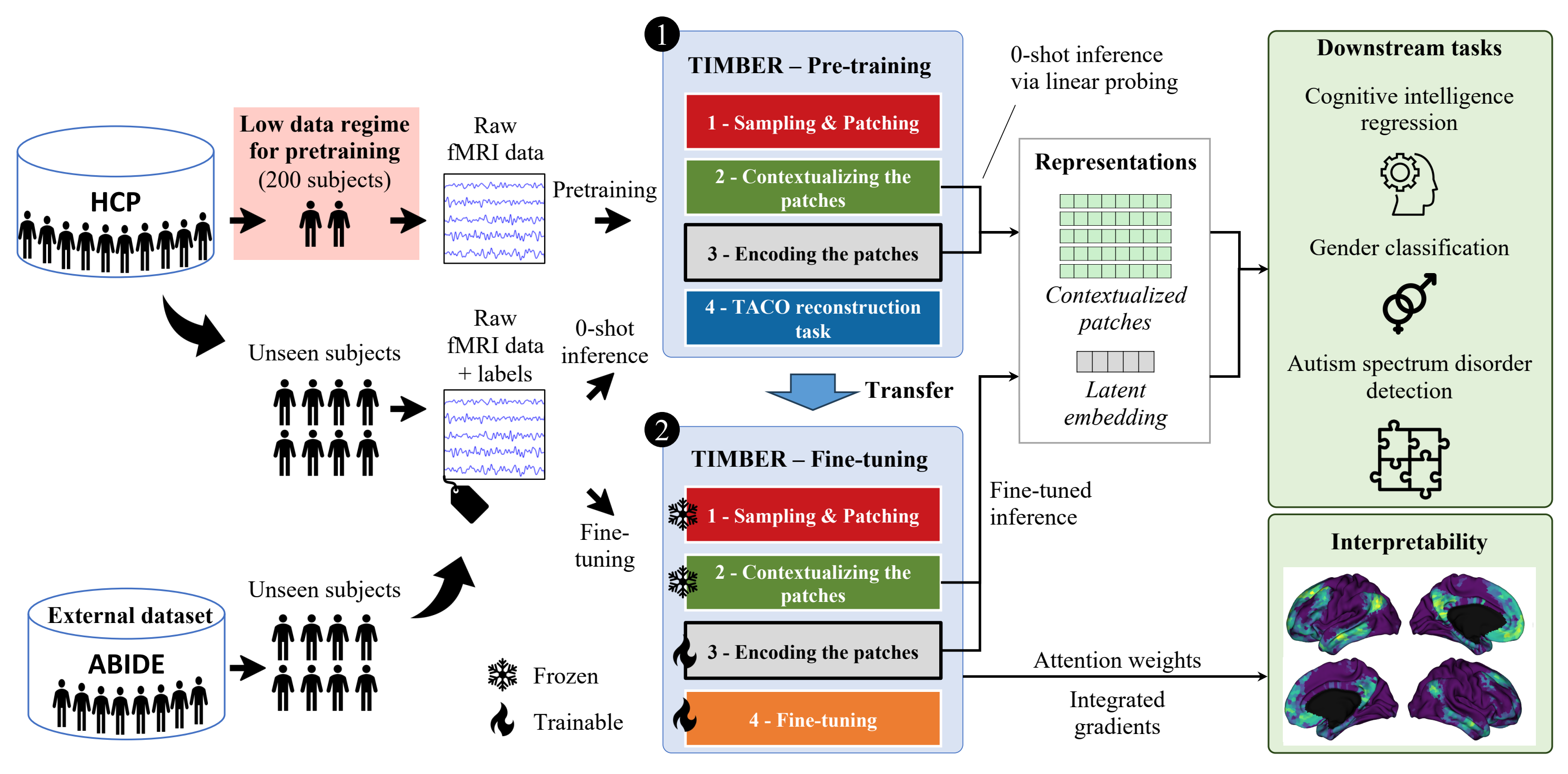
Figure: the framework of the paper. Pretraining (1) samples and patches the recordings, contextualizes the patches, encodes them and learns with the TACO task; fine-tuning (2) adds a head after the encoder.
Why TIMBER
For the fMRI application of the paper:
- Self-supervised. Pretraining needs no labels. The TACO objective predicts each patch of a channel from the patches before it, without any predefined time-position embedding.
- Data-efficient. Pretraining uses 200 HCP subjects, and the representations are competitive with supervised baselines on gender classification and cognitive score prediction.
- Interpretable. The attention of the encoder shows which patches each latent query reads, and integrated gradients highlight the regions behind each prediction.
- Transferable. The same pretrained model transfers to an external clinical dataset (ABIDE I, autism detection).
- Atlas-free. The model reads every channel (cortical vertex) directly, with no parcellation and no handcrafted connectivity measure.
What the model does
- Sampling and patching. Random channels and random time windows of a recording are cut into temporal patches.
- Contextualizing. The contextualizer makes the patches aware of the other channels and of their past.
- Encoding. The encoder summarises all the patches of an entity in a latent embedding of 512 latent queries.
- Task. Pretraining decoders (TACO) learn from the patches; a head predicts a target after finetuning.
The TACO objective
TACO (Time-Aware COnditional reconstruction) is the pretraining task of TIMBER. Its benefits:
- No time prior. TACO does not use a predefined time-position embedding, such as sinusoidal or rotary encodings. Such an embedding imposes a fixed assumption on the temporal structure, which can hurt the capture of brain dynamics. TACO lets the model infer the temporal relations from the data.
- Conditioned on context. The prediction of a patch is conditioned on the contextualized patches and on the latent embedding of the whole entity, so the model learns global structure, not only the next few samples.
- Many training samples. The task works on single patches. A run gives about 15,000 patch-level samples, which is why TIMBER learns from few subjects.
- Better representations. The paper's ablation study shows that the TACO reconstruction task improves the prediction score on cognitive intelligence regression, compared to vanilla reconstruction.
What the model learns
TIMBER produces two representations, as in the paper:
- the latent embedding
e: what the encoder returns for an entity, a compact summary of all its patches; - the contextualized patches
z: one representation per channel and per time patch, after the contextualizer.
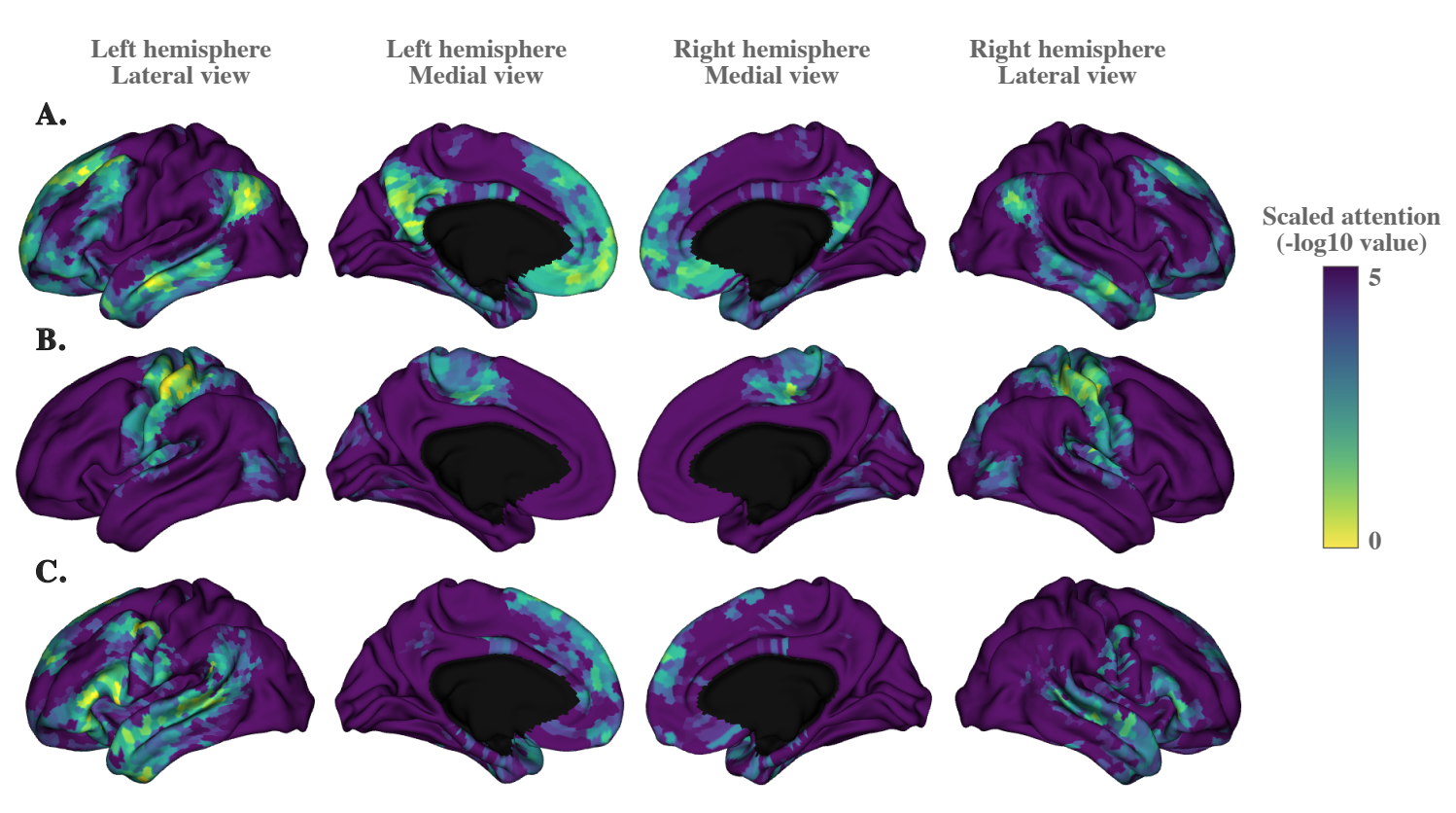
The latent queries (e_queries in the architecture figure) are not representations. They are the learned queries of the encoder: each one reads the contextualized patches through attention. The figure below shows the attention of three latent queries over the contextualized patches. Each query attends to a different functional network, the default mode network (A), the somatomotor network (B) and language-related regions (C), and no labels were used to learn them.
Install
pip install timber-ts
The distribution is timber-ts; the import name is timber. The source is at github.com/Dubris/timber-ts. Requirements: Python 3.12 or later, PyTorch 2.15 or later, transformers 4.51.3 or later. CUDA, Apple MPS and CPU are supported.
Where to go next
- Architecture and the modules: one page per module.
- Training: the data pipeline, training with Lightning, usage, and the results of the paper.
- Paper experiments: the fMRI application, its settings and how to run it.
- Configuration and Models: the reference of the options.
Citation
Le Bris, A., Barbano, C. A. and Wassermann, D. TIMBER: Data-Efficient Self-Supervised Representation Learning for fMRI Time Series. Under review. Preprint: hal.science/hal-05632181.